
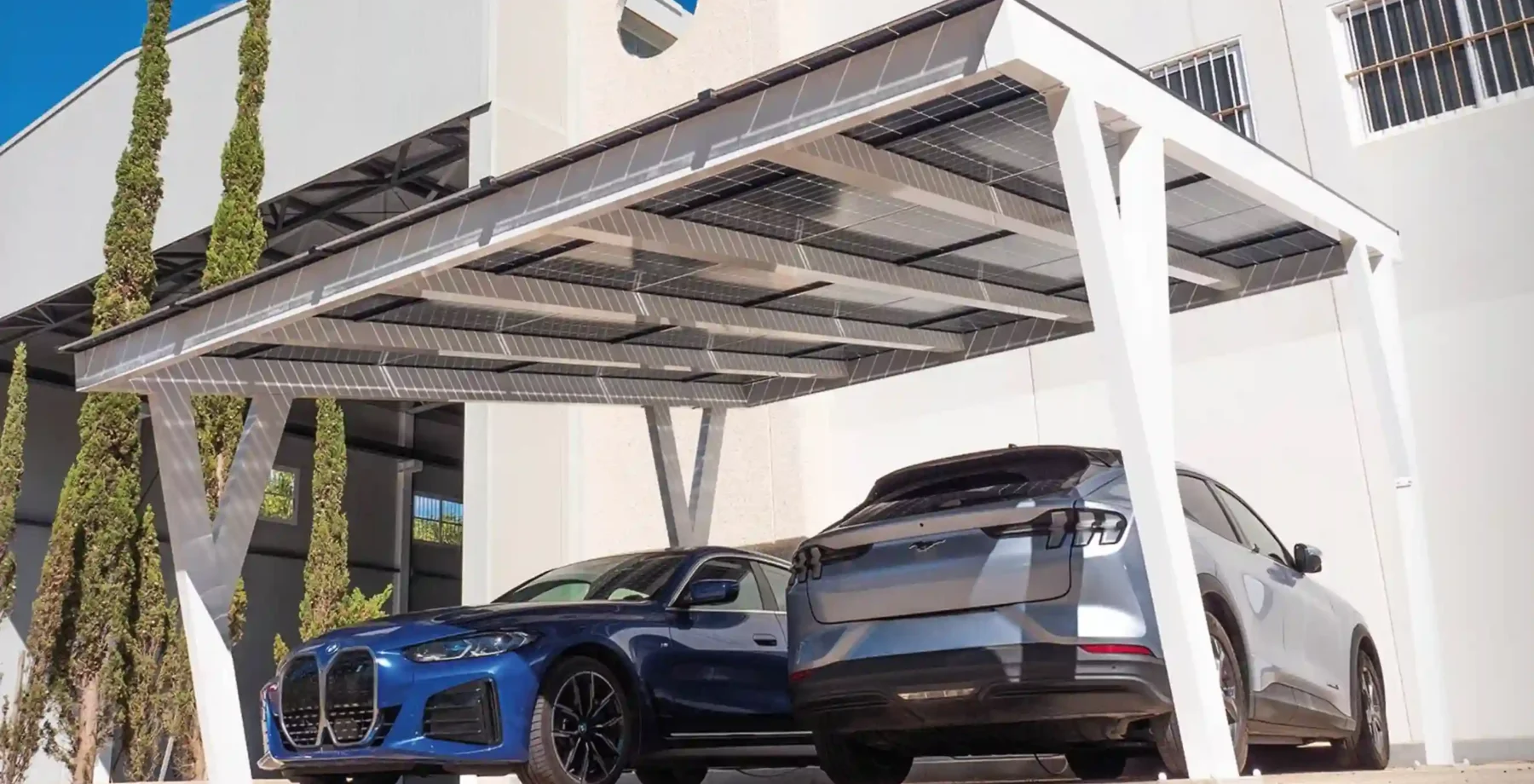
How Much Does a Solar Carport Cost?
There is no single price for a solar carport because the cost depends on the size and specification of both the carport and solar PV system. As a broad UK guide, a residential solar carport can commonly fall somewhere in the region of £10,000 to £20,000+, while larger, more sophisticated installations can cost considerably more.
A useful rule of thumb used across the industry is roughly £10,000 per parking space once groundworks, frame, panels and the electrical connection are all included, however, this rises with higher specifications, added lighting, fascias or branding. As a result, these figures should be treated as indicative rather than a fixed market price.
Pricing for solar carports is higher per kilowatt-peak (kWp) than standard roof-mounted PV. This premium stems from ground engineering, structural steel or aluminium, concrete foundations and underground cabling. Kilowatt-peak (kWp) is a unit of measurement used in solar energy to describe the maximum theoretical power output a solar panel or solar system can produce.
In this guide, we cover the estimated costs for residential and commercial solar carports in the UK, inclusive of the main factors which influence the overall price of these energy-generating canopies.
Residential Solar Carport Cost
- Single Carport: 2.5 kWp – 3 kWp = £10,000 – £12,000
- Double Carport: 5 kWp – 7.5 kWp = £15,000 – £20,000
- Carport with EV Charger: 5 kWp – 7.5 kWp = £15,000 – £24,000
- Carport with EV Charger & Battery Storage: 5 kWp – 10 kWp = £18,000 – £30,000
Commercial Solar Carport Cost
- Small Commercial Carport (20 Bays): 30 kWp – 50 kWp = £36,000 – £60,000
- Medium Commercial Carport (100 Bays): 150 kWp – 200 kWp = £150,000 – £210,000
Main Factors Driving the Cost of Solar Carports
- Size of the Carport: A single-car carport will naturally require less structural material and fewer solar panels than a two-car or multi-bay structure, hence this will consequently affect the overall cost.
- Structural Design: The choice of material and design affects the final price as well. This is because aluminium and steel structures can differ in material costs, fabrication, finishing and installation requirements.
- Solar Panel Specification: Solar panels are available in different sizes, efficiencies and prices. Higher-efficiency panels can generate more electricity from a given roof area, which can be particularly useful where the available carport roof is limited.
- An Inverter: Various inverter technologies and capacities have different costs. The inverter should however be appropriately sized for the PV array and designed around the intended electrical system.
- Battery Storage: Battery storage can substantially increase the initial cost as its purpose is to store electricity generated when production exceeds immediate demand, so that it can potentially be used later.
- EV Charging: An EV charger can make the system particularly attractive for electric vehicle owners because solar generation could potentially be directed towards vehicle charging. However, this comes at an additional cost.
- Groundworks and Electrical Installation: Ground conditions, foundations, cable routes, distance to the consumer unit or distribution board, plus the location of other electrical equipment can all affect installation requirements and costs.
Conclusion
The cost of a solar carport varies enormously with scale and specification, from roughly £10,000 for a modest domestic single-bay system, up to hundreds of thousands of pounds for a large commercial canopy.
Is it worth the investment? This depends on what you are trying to achieve. A solar carport should not be evaluated solely on whether the solar panels generate enough electricity to recover their entire installation cost. The structure itself also provides a useful function by creating covered parking.
The financial case becomes more interesting when the solar carport is used alongside an EV, battery storage or a property with substantial daytime electricity consumption. Nonetheless, projected savings should always be treated as estimates rather than guarantees.
Solar generation varies with weather, orientation, shading and system design, while electricity prices and export payments can change over time. As a result, a reputable quotation should ideally show the proposed system size, expected generation and assumptions used to calculate potential savings.
This article is intended as general guidance and reflects UK market conditions as understood at the time of writing. Costs can change over time, always confirm current figures and requirements before committing to a project.